

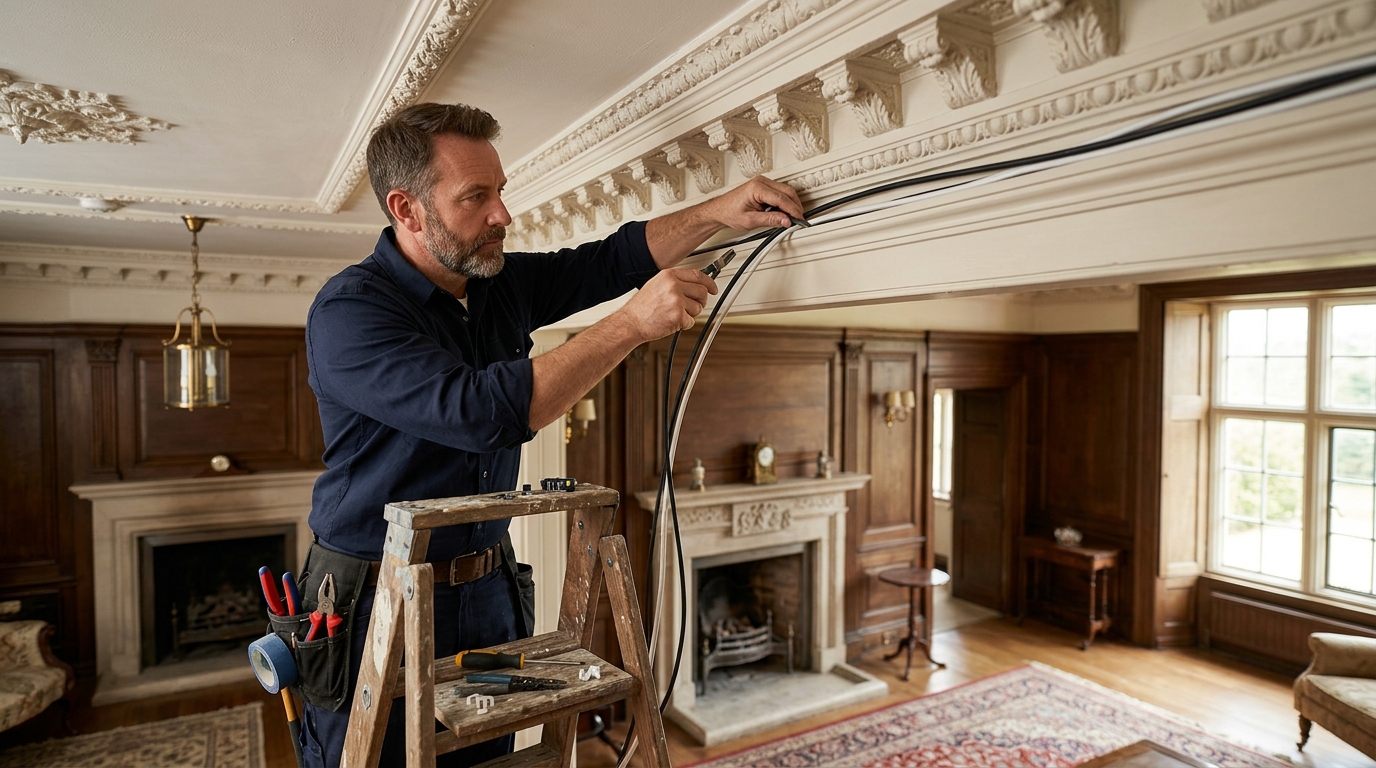
If you own a period home, you already know the challenge: the top methods for concealing modern wiring in character properties have to work around features that no standard electrician’s handbook ever anticipated. In 2026, a striking 87% of homeowners now prioritise “clutter-free” designs where technology and storage are concealed behind panels or integrated into the architecture, which means the expectation of invisible wiring has gone from luxury to absolute standard, especially in older homes where exposed cable runs can completely undermine a carefully preserved aesthetic.
Key Takeaways
| Question | Answer |
|---|---|
| What is the best method for hiding wires in a period property? | Running cables through wall cavities or inside hollow skirting boards is generally the most discreet approach, preserving original features while keeping wiring completely out of sight. |
| Can you chase cables into lath and plaster walls? | Yes, but it requires significant experience and delicacy. Lath and plaster is fragile, so professional assessment is strongly recommended before any chasing work begins. |
| Is surface trunking acceptable in a listed building? | Often yes, particularly if it matches the period aesthetic. Always check with your local authority for listed building consent requirements first. |
| Does hidden wiring add value to a character property? | Absolutely. Modern, compliant electrical installations improve both saleability and the property’s perceived quality, often recouping more than the installation cost. |
| Do I need an EICR after rewiring a character property? | Yes. An Electrical Installation Condition Report is required on completion to certify that the work is safe and compliant with current standards. |
| Who should I use for concealing wiring in a period home? | An experienced electrician with a track record in character properties is essential. The materials and structure of old buildings demand a very different skill set from standard new-build work. |
| How much more does rewiring a character property cost? | Typically 30-50% more than a modern equivalent, due to preservation requirements, restricted access, and the care needed around original features. |
Why Concealing Wiring in Character Properties Is a Different Challenge Altogether
Standard modern houses are built with cable runs in mind. The stud walls, plasterboard cavities, and accessible floor voids make hiding wires relatively straightforward.
Character properties are a different world entirely. Stone walls, solid brick, lath and plaster, decorative cornices, exposed beams, and thatched roofs all create barriers and complications that simply don’t exist in newer builds.
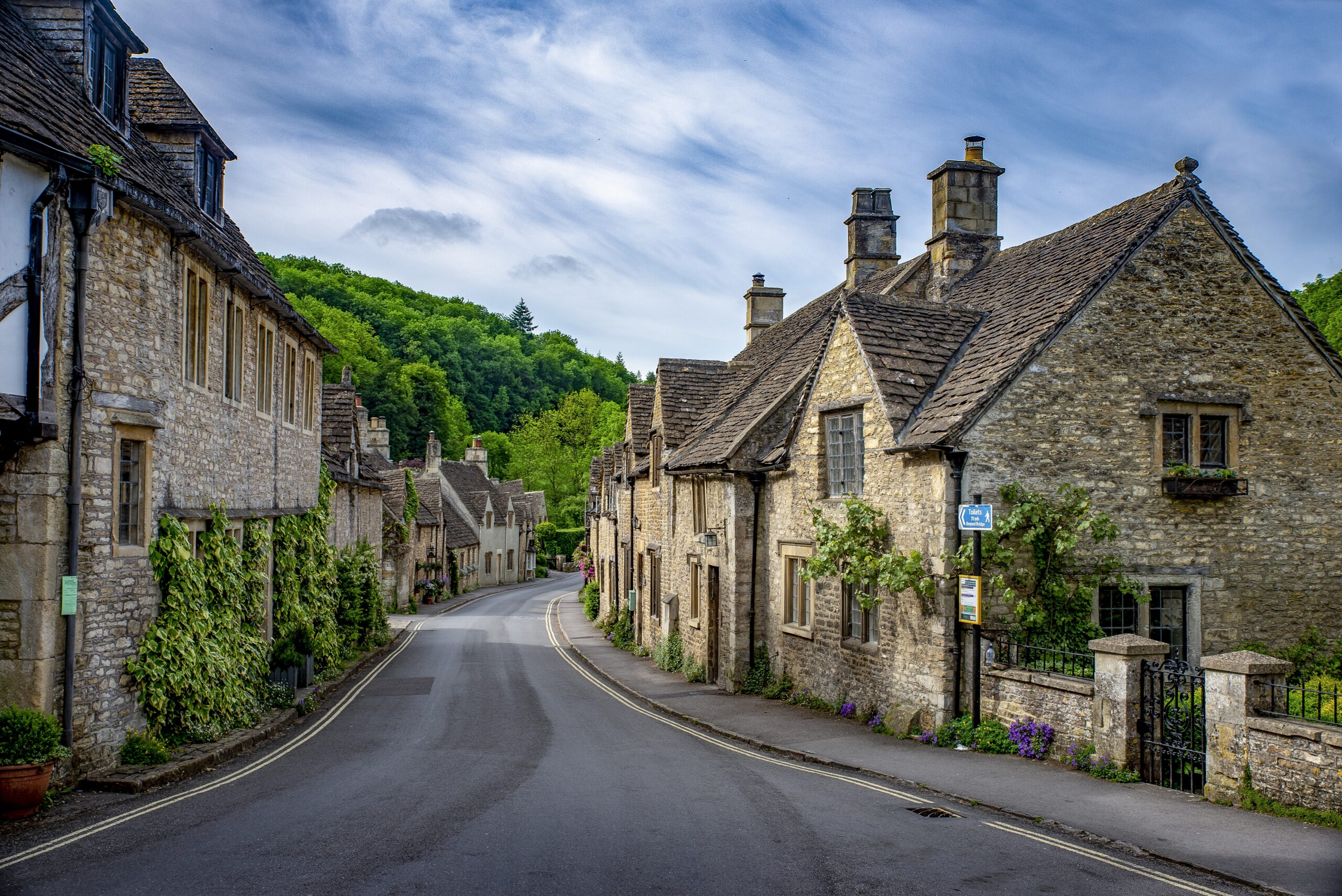
We work across Wiltshire with homes that have stood for hundreds of years, and we’re no stranger to the intricacies these buildings present. The features that give these properties their charm are often the exact same features that make concealing modern wiring a genuine craft, rather than a basic task.
Getting it wrong can mean visible patches on irreplaceable plasterwork, cracked cornices, or cable runs that look completely out of place. Getting it right means your home functions as a modern living space while still looking exactly as it should.
This infographic presents three practical methods for concealing wiring in character properties. Use these insights to improve aesthetics and safety in design.
Top Methods for Concealing Modern Wiring: Running Cables Through Wall Cavities
Where wall cavities exist, routing cables through them is often the cleanest solution available. It keeps wiring completely hidden and avoids any visible surface disturbance.
In solid stone or solid brick properties, true cavities are rare. But timber-framed sections, partition walls added in later periods, and floor voids between storeys frequently offer usable runs that an experienced electrician can work with.
The key is knowing exactly where these opportunities exist before you start. We always carry out a thorough survey first to map out the viable routes, rather than guessing and causing unnecessary damage.
- Best for: Timber-framed sections, internal stud partition walls, floor voids between levels
- Considerations: Requires careful probing to avoid insulation, pipes, and existing cables
- Skill level: Professional only in most character properties
This method is often combined with carefully positioned outlet and switch positions to minimise the total cable run length and reduce the number of access points needed.
Using Hollow Skirting Boards and Architrave as Cable Channels
One of the most widely used top methods for concealing modern wiring in character properties is repurposing or replacing skirting boards and architrave with hollow versions that accommodate cable runs internally.
Modern hollow skirting systems are available in profiles that closely replicate traditional period designs, including ogee, torus, and ovolo styles. From a distance, and even up close, they are virtually indistinguishable from solid timber equivalents.
This approach works particularly well along ground floor walls, around door frames, and between rooms where cables need to travel horizontally without crossing open plaster surfaces.
“In 2026, high-density polystyrene skirting with built-in cable channels has become widely recognised as a gold standard option, prized for being 100% waterproof and requiring no secondary painting, while replicating traditional wood grains convincingly.”
For landlords and homeowners who want a clean result without extensive plasterwork, hollow skirting is often the most practical and cost-effective route available.
Top Methods for Concealing Modern Wiring: Surface-Mounted Trunking That Actually Suits the Property
When chasing cables into walls or routing through cavities is genuinely not possible, surface-mounted trunking remains a legitimate and often very acceptable option, provided it is specified and installed correctly.
The critical factor is choosing trunking profiles and finishes that are sympathetic to the property’s age and style. Square white plastic trunking in a Georgian hallway looks completely wrong. But a correctly specified dado-height trunking in a painted finish, or a mini trunking run along a cornice line in a matching colour, can be practically invisible.
Period-style cornice trunking is a particularly effective solution where ceiling heights are generous, as the cable run sits in a zone where the eye naturally expects to see an architectural detail.
- Square or rectangular mini trunking: Ideal for short horizontal runs at skirting or dado height
- Cornice-profile trunking: Excellent for rooms with high ceilings where a decorative line is expected
- Architrave trunking: Fits directly over door frames to carry cables vertically without any plasterwork
Colour-matching trunking to wall finishes is a simple step that makes a significant difference to the final result.
Working with Lath and Plaster: The Method That Demands the Most Respect
Lath and plaster walls and ceilings are one of the defining features of pre-Victorian and Victorian properties, and they are also one of the most common obstacles when it comes to concealing wiring.
Unlike modern plasterboard, lath and plaster cannot simply be drilled through freely or chased in the same way. The structure relies on the integrity of each individual lath, and damage to even a small area can cause cracking and crumbling well beyond the immediate work zone.
The approach we use involves careful probing to locate the lath positions, using the narrowest possible access points, and routing cables through the void behind the plaster wherever the depth of the wall allows.
Repairs to any access points are carried out using appropriate lime-based materials to match the original finish, rather than modern gypsum plasters that can cause long-term compatibility problems in heritage walls.
Most people don’t realise that a poorly planned cable run through lath and plaster can result in remedial plastering costs that far exceed the original wiring budget. Taking it slowly and methodically from the start saves significant time and money.
Top Methods for Concealing Modern Wiring: Chasing Conduit into Solid Masonry
In solid stone or solid brick properties where no cavity exists and surface trunking is not acceptable, chasing conduit directly into the masonry wall is often the right answer.
This involves cutting a narrow channel into the wall surface, laying conduit within it, and then making good the finish over the top. When done properly, the result is completely invisible once decorated.
The challenge in character properties is managing the dust, debris, and vibration that chasing creates, particularly where original decorative features are nearby. Careful masking, specialist narrow-angle grinders, and often hand-chiselling close to cornices or other features are standard practice for us.
- Survey the wall to check for existing services before cutting begins
- Mark out the route to minimise the channel length and avoid decorative elements
- Cut the chase using appropriate tools for the wall material
- Install conduit and draw cables through before the channel is closed
- Make good with a compatible render or plaster and allow to cure fully before decoration
In stone properties especially, chasing should always be carried out by someone who understands the difference between loadbearing and non-loadbearing sections. Cutting into the wrong area can have structural consequences that go far beyond aesthetics.
Boxing In Pipes and Cables: A Versatile Option for Awkward Runs
Where cables need to travel along a route that cannot be hidden within the wall structure, boxing in is a practical and often sympathetic approach, particularly in utility areas, kitchens, and bathrooms within character homes.
Timber boxing can be built to match existing architectural details, painted to blend with surrounding surfaces, and even profiled to mimic period features. In the right context, a well-built boxing run looks like a deliberate design feature rather than a concealment measure.
Boxing is also useful in areas where future access to the wiring may be needed, since removing a panel is far less disruptive than opening a chase in a historic wall.
- Best for: Utility rooms, loft conversions, basement areas, kitchen runs
- Material choices: MDF with timber trim for paintable finishes; hardwood panelling for more visible locations
- Access consideration: Build in removable sections wherever future maintenance access is likely to be needed
Concealing Wiring Behind Period Panelling and Feature Walls
Many character properties already have timber panelling, wainscoting, or decorative wall treatments. These features create a natural void behind them that can be used very effectively as a cable route, without any intervention in the wall structure itself.
Where panelling does not already exist, adding it in a style appropriate to the property is one of the top methods for concealing modern wiring in character properties because it serves two purposes simultaneously: it enhances the period aesthetic while providing a clean, accessible cable management system behind it.
Georgian-style raised and fielded panel designs, Jacobean linenfold patterns, and simple Victorian tongue-and-groove boarding all offer a period-appropriate aesthetic that is well within the reach of a competent joiner working alongside an electrician.
The key is ensuring that socket and switch positions are planned before the panelling is fitted, so outlets emerge at logical and aesthetically appropriate points in the panel layout.
Planning Smart Home Wiring in Heritage Properties: Getting It Right the First Time
In 2026, character properties are increasingly being upgraded with smart home technology, and this creates a new layer of complexity for cable concealment. Modern character homes now require up to 50% more electrical capacity than those updated just 15 years ago, driven by EV chargers, home automation, and whole-house audio-visual systems.
This means that traditional approaches of simply “tucking a wire behind the skirting” are no longer sufficient. The volume and variety of cabling involved in a smart home upgrade, data cables, power cables, speaker runs, and control wiring, demands a properly planned concealment strategy.
The most important principle is to plan the full scope of what you want the property to do before any cables are hidden. Retrofitting additional data runs through a wall that has already been made good is significantly more expensive and disruptive than running everything in a single planned phase.
- CAT6 data cabling should be planned alongside power circuits, not as an afterthought
- Central distribution points (media plates or structured wiring cabinets) can be housed in cupboards or built-in furniture to keep them out of sight
- Wireless systems can reduce cable volume, but they still require power runs and WAP (wireless access point) installations that need to be planned and concealed
Working with an electrician who understands both traditional building methods and modern smart home requirements is genuinely the most important factor in getting this right.
When Professional Help Is Not Just Recommended, It Is Essential
We’d be the first to say that some straightforward cable tidying is well within the capabilities of a competent homeowner. Clipping a short run of cable behind furniture, or fitting a simple surface-mounted trunking section, does not require a specialist.
But in a character property, the situations where professional involvement becomes genuinely essential are frequent. Lath and plaster, loadbearing stone walls, decorative cornices, listed building restrictions, and the presence of old wiring systems (including rubber-insulated cables from earlier decades) all create scenarios where getting it wrong can be both dangerous and extremely expensive to fix.
We work with homeowners, landlords, and builders across Wiltshire on exactly these kinds of projects, and the properties we work in are the same ones that give this county its identity and character. That matters to us, and it shapes how we approach every job.
An NICEIC-registered electrician will also ensure that all work is certified on completion, giving you an Electrical Installation Condition Report that confirms the installation meets current standards. This is not optional for rental properties and is strongly advisable for any property sale.
“40% of homeowners in 2026 plan to outsource renovation tasks entirely to professionals, up from 32% the previous year, specifically to handle complex infrastructure like hidden wiring. The trend clearly shows that people are moving away from DIY visible cable tracks and toward professionally installed, seamless solutions.”
Does Investing in Concealed Wiring Actually Pay Off in a Character Property?
The short answer is yes, and often more than homeowners expect. Exposed wiring in a character property sends a specific message to buyers and valuers: that the electrical system is old, potentially unsafe, and will require significant work.
Buyers frequently overestimate the cost of replacing old wiring by 50 to 100%, meaning that what is actually a manageable investment gets priced in negotiations as a near-impossible project. Investing in properly concealed, modern wiring before a sale removes that uncertainty entirely and protects your asking price.
Beyond sale value, there are practical day-to-day benefits. A property with modern, correctly concealed wiring can accommodate the electrical demands of contemporary life, including EV charging, smart home devices, and high-capacity kitchen and bathroom circuits, without the visual compromise of surface cable runs or the safety concerns of an ageing installation.
For landlords especially, the combination of improved safety, lower insurance premiums, and compliance with current electrical safety regulations makes the investment in concealed modern wiring a straightforward decision, not just a cosmetic one.
Conclusion
The top methods for concealing modern wiring in character properties are not a one-size-fits-all list. Every period building presents its own specific combination of materials, features, and constraints, and the right approach depends on an honest assessment of what the building will and will not allow.
Whether that means running cables through floor voids, fitting hollow skirting boards, chasing conduit into solid masonry, or adding sympathetic timber panelling as a dual-purpose feature, the goal is always the same: a home that functions for modern life while looking exactly as it should.
If you’re working on a character property in Wiltshire and you want to get the concealment done properly, without unnecessary damage and without cutting corners on safety, we’d love to help. Get in touch with us today for a no-obligation conversation about what your property needs, and we’ll come to you and take a proper look before any work begins.
We pride ourselves on providing friendly, professional services that treat your property with the care and consideration it deserves. After all, these buildings have stood for centuries, and they deserve an electrician who understands that.