
Knowing how to pass your residential EICR inspection successfully can be the difference between a smooth, stress-free certificate and a costly cycle of re-inspections and emergency repairs. Faulty electrical installations are responsible for approximately 21% of accidental house fires in England, which means this inspection isn’t just a paperwork exercise — it genuinely protects your home, your family, and your finances.
Key Takeaways
| Question | Quick Answer |
|---|---|
| What is an EICR? | An Electrical Installation Condition Report is a detailed inspection of your home’s wiring, consumer unit, and circuits carried out by a qualified electrician. |
| How often do I need one? | For owner-occupied homes, every 10 years is the recommended interval. Rental properties require one every 5 years by law. |
| What causes most EICR failures? | Lack of RCD (Residual Current Device) protection and outdated consumer units are the two leading causes of an Unsatisfactory result. |
| Who should carry out the inspection? | Only a NICEIC registered contractor or similarly accredited professional should conduct your EICR to ensure the certificate is valid and recognised. |
| How much does an EICR cost in 2026? | Typically between £100 and £350 for a domestic property, depending on size and circuit complexity. |
| What happens if I fail? | You’ll receive a list of coded observations requiring remedial work. Once the work is completed, a re-inspection confirms a Satisfactory outcome. |
| Can I prepare my home beforehand? | Yes. A pre-inspection checklist covering your fuse board, sockets, switches, and earthing arrangements can significantly improve your chances of a first-time pass. |
What Is a Residential EICR and Why Does It Matter?
An EICR, or Electrical Installation Condition Report, is a thorough assessment of all the fixed electrical wiring and equipment within your home. The inspector checks everything from your consumer unit and circuit breakers to your sockets, light fittings, and earthing system.
The result comes back as either Satisfactory (you’re good to go) or Unsatisfactory (remedial work is required). Any issues found are coded — C1 for immediate danger, C2 for potentially dangerous, and C3 for improvement recommended — so you know exactly what needs attention and how urgently.
It isn’t just a safety document, either. Insurance providers are increasingly reviewing EICR records when calculating your home insurance premium, and mortgage lenders sometimes request a valid report as part of the conveyancing process. Getting it right the first time matters more than ever in 2026.
How to Pass Your Residential EICR Inspection: The Pre-Inspection Preparation Checklist
Most homeowners don’t realise that a little preparation before the inspection day can make a real difference to the outcome. We always advise clients to run through a simple checklist in the weeks leading up to their booked appointment.
- Test your smoke and carbon monoxide alarms and replace any expired batteries.
- Inspect all visible sockets and switches for signs of scorch marks, cracks, or discolouration.
- Check your consumer unit (fuse board) — is it a modern, clearly labelled unit with RCD protection?
- Remove any DIY electrical work that was not carried out or certified by a qualified electrician.
- Ensure all light fittings have bulbs fitted so the inspector can test each circuit properly.
- Provide clear access to your consumer unit, loft hatch, and under-floor areas where cabling runs.
- Gather any existing electrical certificates — previous EICRs, Part P notifications, or installation certificates help the inspector understand the history of your system.
Think of it like preparing for an MOT — you wouldn’t turn up without checking the obvious things first. A little attention beforehand can save you both time and money.
This visual guide breaks down the five essential steps to passing a residential EICR inspection. Use the checklist to prepare and avoid common pitfalls.
The Most Common Reasons Homes Fail an EICR Inspection
Understanding what fails an inspection is one of the most practical ways to approach how to pass your residential EICR inspection successfully. Some issues are simple and inexpensive to resolve; others require more involved electrical work.
Here are the most frequently cited reasons for an Unsatisfactory result:
- No RCD protection on socket circuits or circuits supplying outdoor equipment
- Outdated consumer unit — old fuse boards with rewirable fuses rather than modern circuit breakers
- Missing or inadequate earthing and bonding connections at gas and water pipes
- Damaged or deteriorating cables, particularly in older properties with rubber-insulated wiring
- Reverse polarity at socket outlets, meaning live and neutral wires are incorrectly connected
- Lack of protective enclosures on junction boxes in lofts or under-floor spaces
- Non-compliant DIY additions, including sockets or lighting added without proper certification
- Counterfeit or substandard electrical accessories, which are increasingly common with online purchasing
“Most people don’t realise that their electrics are outdated — and in some cases, addressing these issues can be genuinely life-saving.”
RCD Protection: The Single Most Important Factor in Passing Your EICR
If we had to point to the one thing most likely to cause a residential EICR to come back Unsatisfactory, it’s the absence of proper RCD protection. A Residual Current Device monitors the flow of electricity through a circuit and cuts the power within milliseconds if it detects a dangerous imbalance — protecting you from electric shock and reducing the risk of fire.
Homes built before the mid-2000s frequently lack RCD protection on socket circuits, outdoor supplies, and bathroom circuits. If your consumer unit doesn’t have an RCD (or uses a split-load board with only partial RCD coverage), upgrading it is often the single most effective step you can take before your inspection.
The good news is that fitting a modern consumer unit with full RCD protection is a straightforward, well-defined piece of work for a qualified electrician. It doesn’t necessarily mean rewiring your entire property — in many cases, it’s a targeted upgrade that resolves the majority of C1 and C2 observations in one visit.
How to Pass Your Residential EICR Inspection by Upgrading Your Consumer Unit
A consumer unit replacement is the most frequent remedial solution that turns an Unsatisfactory EICR result into a Satisfactory one. If your property still has an old fuse board with ceramic or rewirable fuses, upgrading to a modern unit with RCBOs (combined RCD and circuit breaker devices) will address multiple inspection failures at once.
Here’s what a modern consumer unit upgrade typically includes:
- Full RCD or RCBO protection on all circuits
- Clearly labelled circuit breakers for each zone of the property
- A metal enclosure in compliance with current fire-safety regulations
- Proper main switch isolation
- An updated Electrical Installation Certificate for the work carried out
We always recommend getting this work done before your EICR if your current fuse board is visibly old or non-compliant. It’s far more cost-effective than paying for an inspection, receiving an Unsatisfactory result, completing the upgrade, and then paying for a re-inspection on top.
How to Choose the Right Electrician to Carry Out Your EICR
Not all electricians are authorised to issue a legally recognised EICR. The inspection must be carried out by a qualified, registered professional — and the easiest way to confirm this is to look for NICEIC registration or membership of an equivalent approved body.
We are NICEIC registered contractors, which means all of our work is certified and independently audited to the highest industry standards. That matters when you’re relying on a piece of documentation to satisfy an insurer, a letting agent, or a mortgage lender.
When vetting any electrician for your EICR, check these points:
- Are they on the NICEIC, NAPIT, or ELECSA register? (Always verify directly on the scheme’s website.)
- Do they carry professional indemnity and public liability insurance?
- Can they show you examples of completed EICR certificates they have issued?
- Are they local and familiar with the types of property in your area, including older or period buildings?
It’s also worth noting that 36% of homeowners rely on personal recommendations when choosing an electrician for safety inspections — and that’s a solid starting point, as long as you still verify their credentials independently.
What Happens on the Day of Your EICR Inspection?
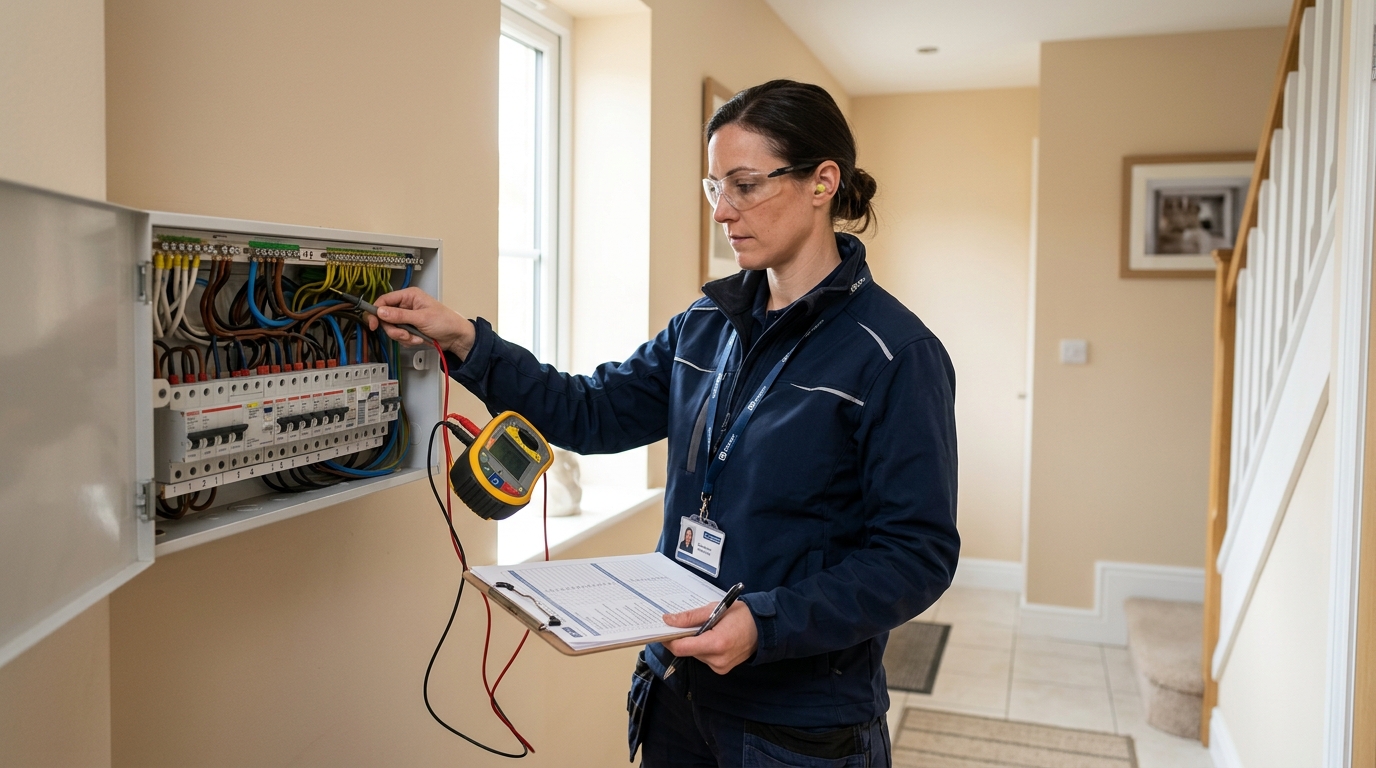
Knowing what to expect on inspection day removes a lot of the anxiety around the process. A residential EICR typically takes between 3 and 4 hours for a standard three-bedroom property, though larger homes or those with complex wiring may take longer.
The electrician will work through the following stages:
- Visual inspection of all accessible wiring, sockets, switches, and the consumer unit
- Dead testing — checking the resistance, insulation, and continuity of circuits with the power off
- Live testing — verifying the operation of circuit breakers, RCDs, and polarity with the power on
- Recording observations — documenting any deficiencies with the appropriate C1, C2, or C3 code
- Issuing the report — either on the day or shortly after, with a full schedule of circuits and findings
During dead testing, the power to individual circuits will be interrupted temporarily. Let other members of the household know in advance so no one is caught off guard by lights or appliances switching off unexpectedly.
How to Pass Your Residential EICR Inspection: Understanding Your Results
Receiving your EICR report and knowing how to read it confidently is a key part of the process. The report contains a schedule of circuits, a schedule of test results, and a section listing all observations found during the inspection.
Here’s a breakdown of what the observation codes mean:
| Code | Meaning | Action Required |
|---|---|---|
| C1 | Danger present — risk of injury | Immediate remedial action required |
| C2 | Potentially dangerous | Urgent remedial action required |
| C3 | Improvement recommended | Not mandatory but advisable |
| FI | Further investigation required | Inspector could not fully assess — investigation needed |
Any C1 or C2 observation results in an overall Unsatisfactory rating. C3 observations alone do not cause a failure — the report can still come back Satisfactory even with C3 items present.
Remedial Work: What to Do After an Unsatisfactory EICR
Receiving an Unsatisfactory report isn’t the end of the world — it’s a clear, actionable list of what needs fixing. In 2026, around 40% of EICR inspections identify safety issues requiring remedial work before a Satisfactory rating can be issued, so you are far from alone if this happens.
For landlords, the legal requirement is to complete all remedial work within 28 days of the inspection (or sooner if a C1 issue requires immediate action). For homeowners, there is no statutory deadline, but acting promptly is strongly advisable.
Once the remedial work is completed by a qualified electrician, they will issue an Electrical Installation Certificate for the work done. You can then request a re-inspection to obtain your Satisfactory EICR, or in straightforward cases, the electrician who carried out the remedial work can sign off the specific observations that have been resolved.
The Cost of an EICR in 2026 and How to Budget Wisely
The average cost for a domestic EICR in 2026 ranges between £100 and £350, depending on the size of your property and the number of circuits involved. A small flat with a handful of circuits will sit at the lower end; a large detached house with multiple outbuildings and extensive circuits will be toward the higher end.
Be cautious of quotes that seem unusually low. A thorough EICR is a detailed, time-intensive process — an inspector rushing through your home in under an hour is unlikely to identify all the issues that a careful, methodical inspection would catch. A cheap inspection that misses a C1 fault doesn’t save you money; it puts your home at risk.
Here’s how to budget sensibly for the full process:
- EICR inspection fee: £100 to £350 depending on property size
- Consumer unit upgrade (if needed): typically £400 to £900 fitted
- Additional bonding and earthing work: usually £80 to £200
- Socket or switch replacements: generally £30 to £80 per item
- Re-inspection fee (if required): often reduced or included by the same contractor
Also worth noting: insurers may increase property premiums by 50% to 100% if a property lacks evidence of a satisfactory electrical check every five years. Factor that into the total value of getting the inspection done promptly — it’s an investment, not just a cost.
EICR Requirements for Landlords and Homeowners in 2026
The regulatory landscape for EICRs in 2026 is clear for rental properties and increasingly important for owner-occupiers too. If you’re a landlord in England, you are legally required to hold a valid EICR carried out every five years, with a copy provided to your tenants and local authority on request.
For owner-occupiers, there is no current legal obligation to hold an EICR, but it is strongly recommended every 10 years (or when buying or selling a property). With homeowners, landlords, and builders all facing increased scrutiny from insurers and mortgage lenders, having an up-to-date report is fast becoming standard practice rather than an optional extra.
In 2026, civil penalties for serious breaches of electrical safety regulations can reach up to £40,000. For landlords who ignore or delay remedial work identified in a report, the financial and legal exposure is simply not worth the risk.
Conclusion: How to Pass Your Residential EICR Inspection Successfully, First Time
Passing your residential EICR inspection successfully comes down to three core principles: preparation, using the right professional, and acting quickly on any findings. Run through the pre-inspection checklist, ensure your consumer unit offers full RCD protection, and book your inspection with a NICEIC registered electrician who will give you a thorough, honest report.
If you do receive an Unsatisfactory result, don’t panic. In most cases, targeted remedial work — often a consumer unit upgrade or the addition of RCD protection — is all that’s needed to bring your home’s electrics up to standard and secure that Satisfactory certificate.
We work with homeowners, landlords, and property professionals across Wiltshire, providing detailed EICR inspections and all associated remedial work. All our inspections are carried out by NICEIC registered electricians, and all our work is certified. If you’d like a straightforward conversation about your electrical installation — no jargon, no pressure — get in touch with us today and we’ll be happy to help.