
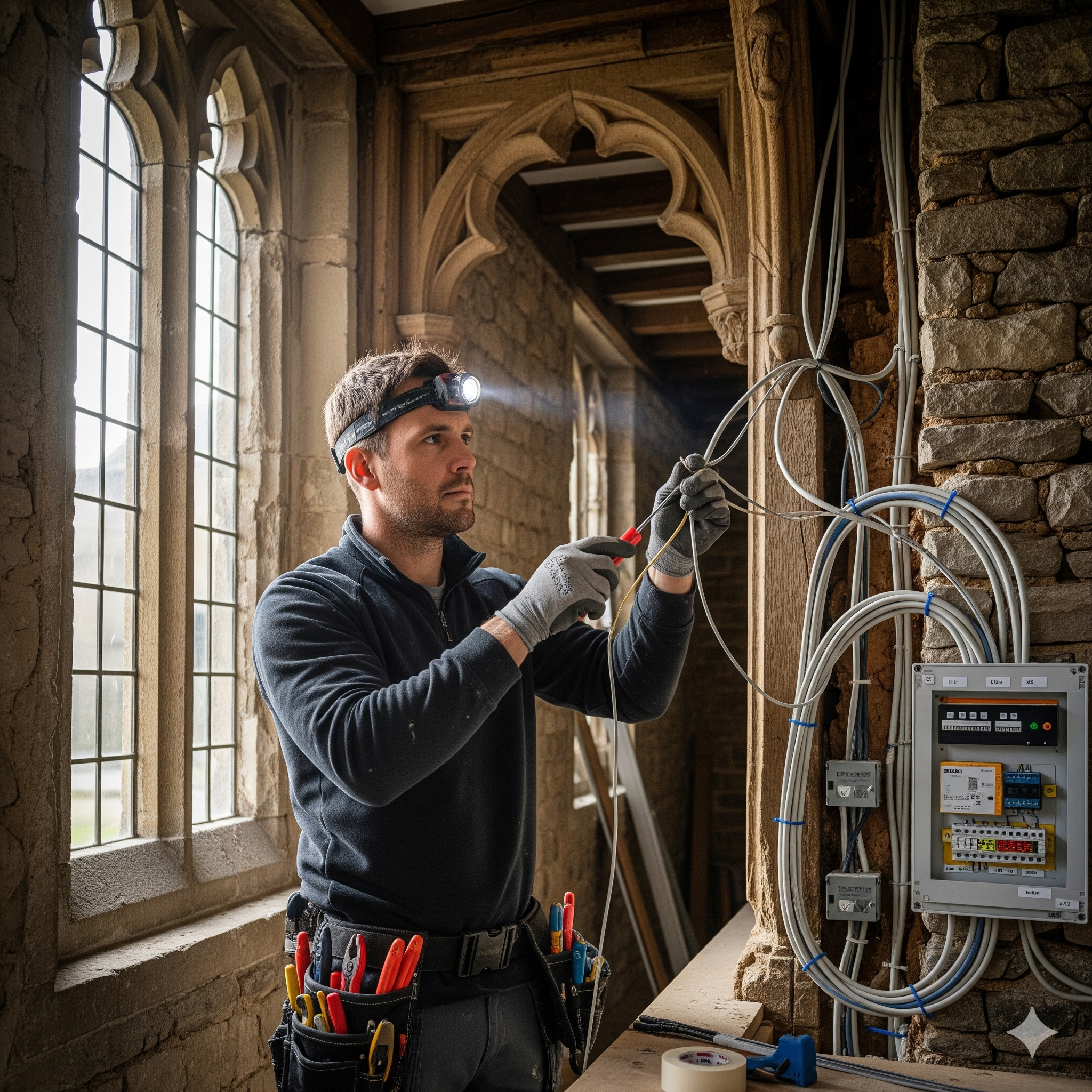
When it comes to professional wiring restoration for traditional Wiltshire period properties, the stakes could not be higher. A sobering 53.4% of all accidental dwelling fires in England are caused by electrical hazards, and for owners of timber-framed cottages, thatched farmhouses, and listed stone buildings across Wiltshire, ageing or degraded electrical installations represent one of the most serious and preventable risks to their homes.
Key Takeaways
Why Traditional Wiltshire Period Properties Need Professional Wiring Restoration
Wiltshire has one of the highest concentrations of listed buildings, thatched properties, and pre-war homes of any county in England. Many of these properties were wired decades ago, and the electrical systems they contain were never designed to cope with the demands of modern living.
Rubber-sheathed cables from the 1950s and 1960s become brittle and crack over time, exposing live conductors inside walls and under floors. Fabric-covered wiring from even earlier periods presents a significant fire and shock risk. Neither type comes close to meeting the requirements of BS 7671, the current UK wiring standard.
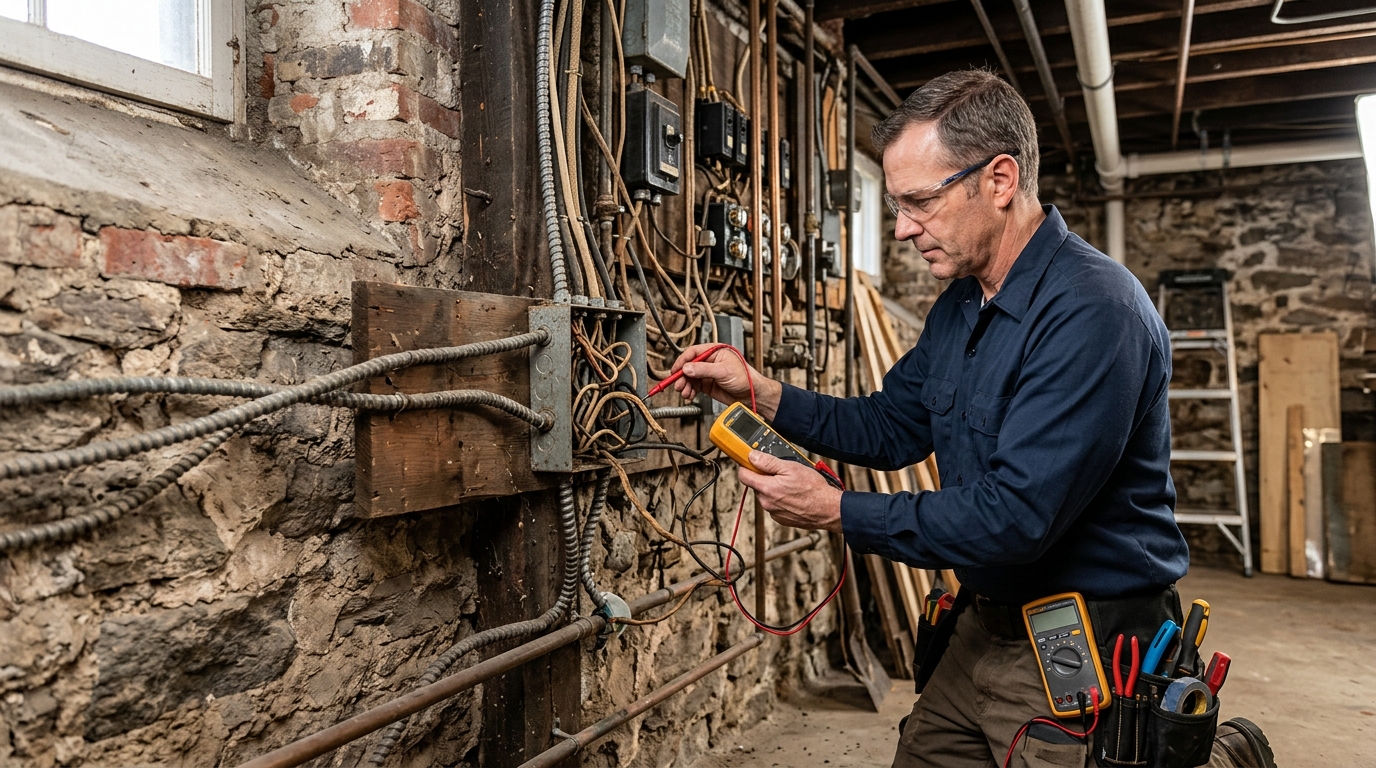
Beyond safety, there is a practical problem: old circuits simply cannot supply the load that modern households require. An installation designed for a handful of light fittings and a single ring circuit will struggle to power an induction hob, a heat pump, an EV charger, and multiple devices simultaneously without tripping or overheating.
Professional wiring restoration for traditional Wiltshire period properties addresses both the immediate safety risks and the longer-term capacity requirements in a single, planned programme of work. Done correctly, it gives you a property that is safe, insurable, and ready for the next several decades of use.
Warning Signs Your Wiltshire Period Home Needs Wiring Restoration
Knowing when to act is critical. The following signs indicate that your property’s wiring may have reached the end of its safe working life.
- Frequent circuit tripping or fuse blowing without any obvious overload
- Flickering or dimming lights, particularly when other appliances are switched on
- Discoloured, warm, or scorch-marked sockets and switches
- A burning smell near outlets or the consumer unit
- Old-style fuse box with ceramic fuses and no RCD protection
- Visible rubber or fabric-covered cables, especially in loft spaces or under floors
- A property that has not been rewired since before 1980
- Round-pin sockets or very few sockets per room
If you recognise any of these in your Wiltshire home, the first step is always an independent Electrical Installation Condition Report (EICR), which will confirm the condition of the existing installation and identify any urgent remedial work.
What Professional Wiring Restoration for Traditional Wiltshire Period Properties Involves
Professional wiring restoration for traditional Wiltshire period properties is a structured process that goes well beyond simply replacing cables. Here is what you can expect when you work with us.
Stage 1: Survey and Assessment
We begin with a thorough survey of your existing electrical installation. This covers every circuit, the condition of the consumer unit, the state of any existing cabling we can access, and the specific access constraints presented by your property’s construction.
Period buildings often have solid stone walls, lath-and-plaster ceilings, and hardwood floors that require special care. We map out all of this before a single cable is touched.
Stage 2: Detailed Quotation
Following the survey, we provide a comprehensive, fixed-price quotation with no hidden costs. We break down the scope clearly so you know exactly what is being replaced, where new circuits are being installed, and how we plan to route cables through the fabric of the building.
Stage 3: Installation
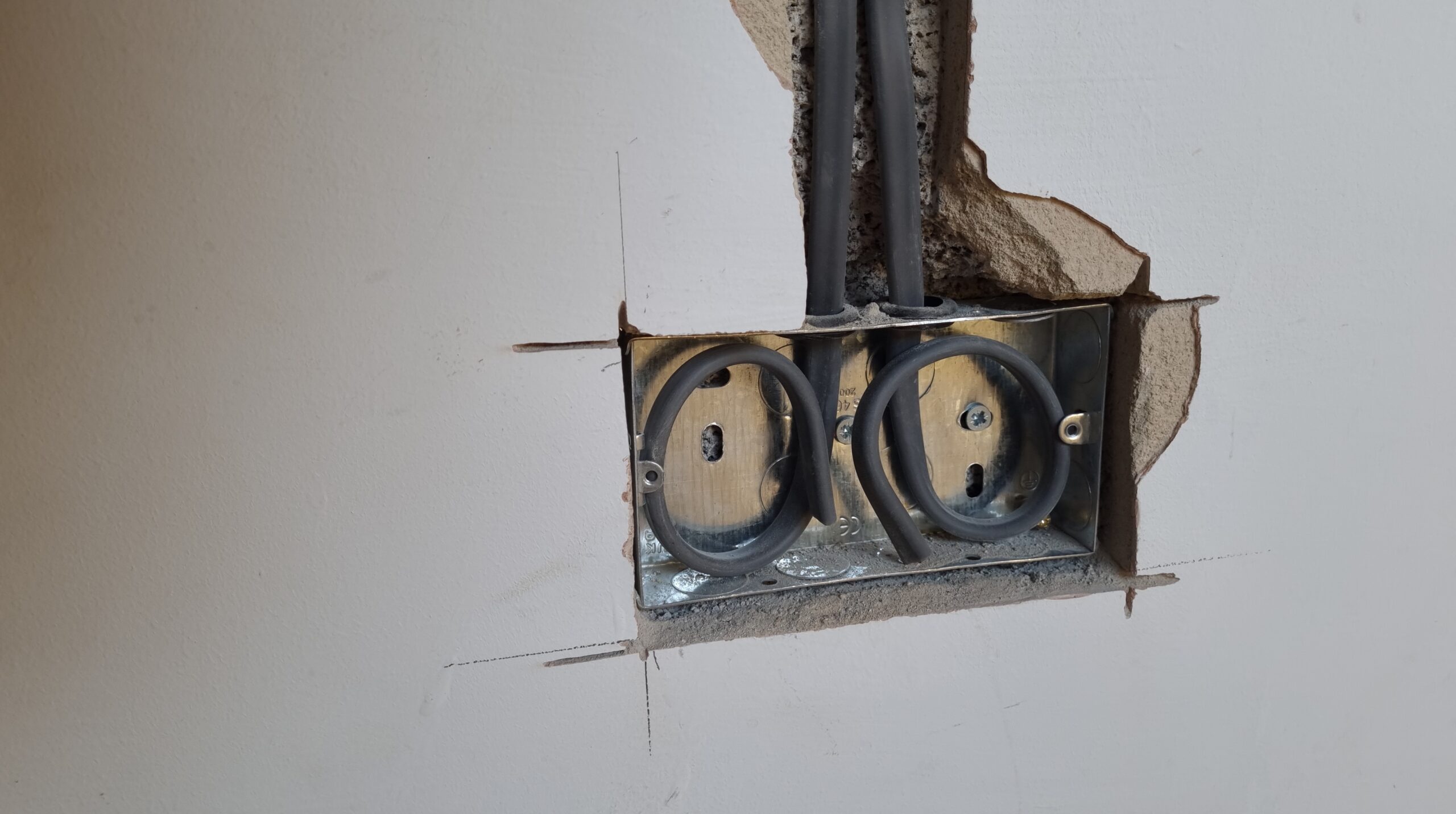
Our experienced team works methodically through the property, room by room. Old cabling is removed and replaced with modern, fire-resistant wiring. Back boxes and sockets are upgraded, and the consumer unit is replaced with a current-specification unit carrying full RCD or RCBO protection.
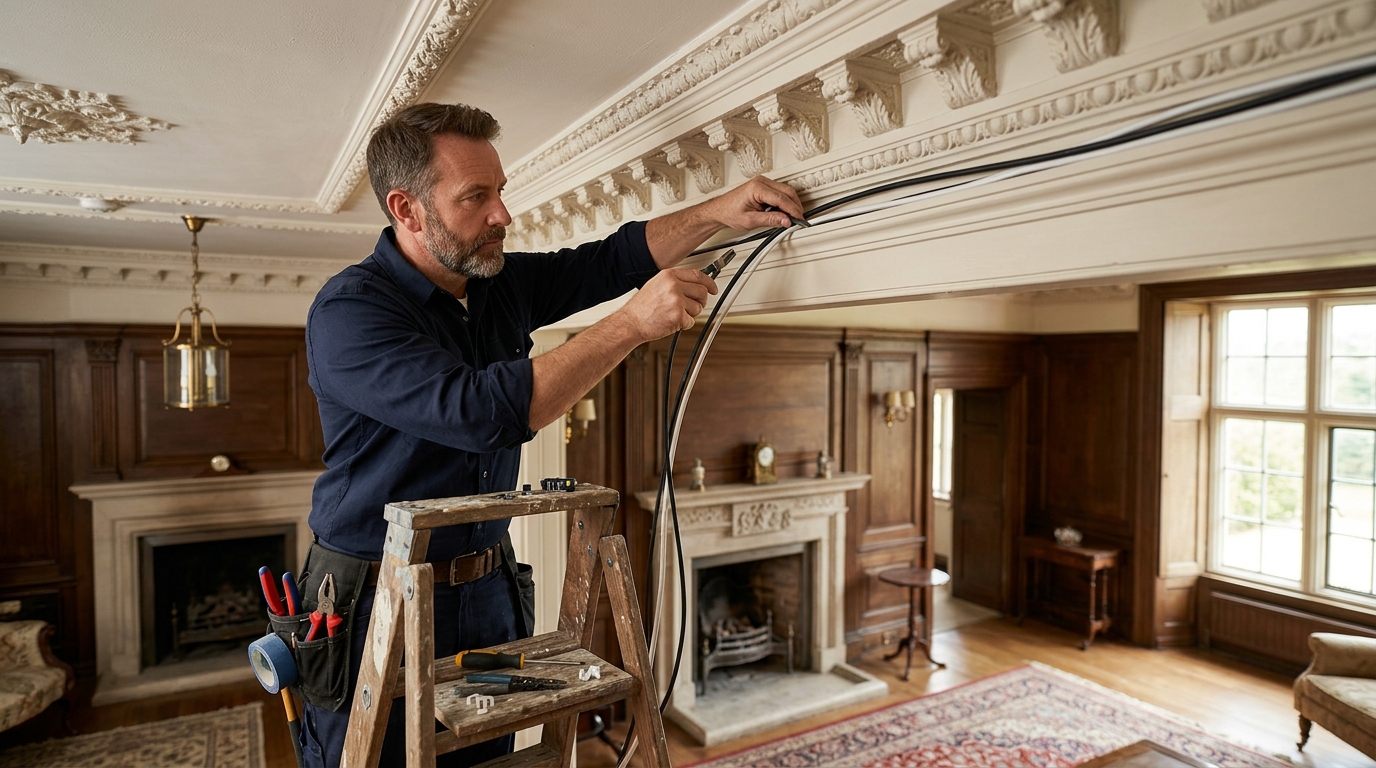
Where the property has listed building status or is particularly sensitive, we apply specialist techniques including surface-mounted conduit finished to match the surrounding décor, and carefully planned first-fix channels that minimise disruption to original plasterwork.
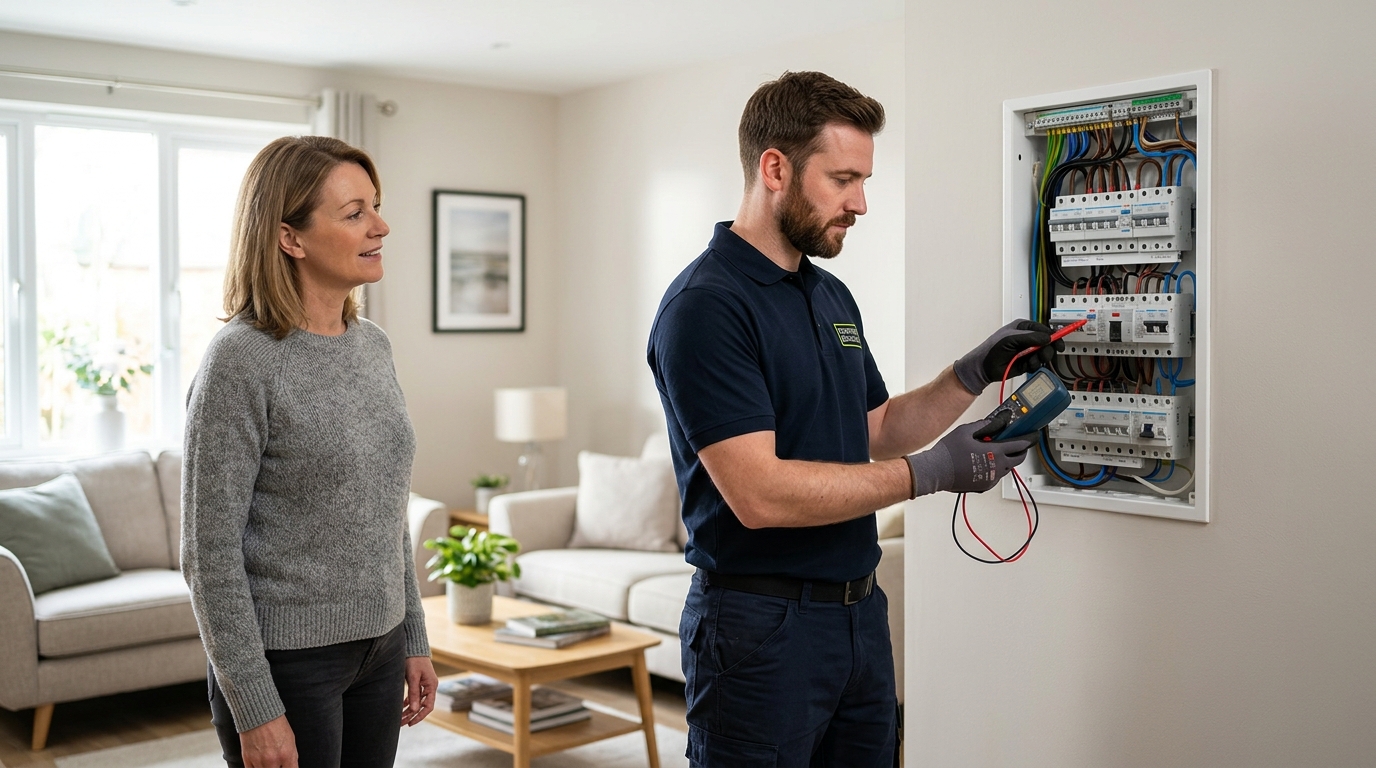
Stage 4: Testing and Certification
Once installation is complete, every circuit is tested to BS 7671 before we sign off the work. You receive a full Electrical Installation Certificate, which you will need for insurance purposes and for any future sale of the property.
EICR Testing: The Essential First Step for Wiltshire Heritage Homes
Before any wiring restoration begins, an EICR gives you a clear, independent picture of where your installation currently stands. It is a detailed inspection of all fixed wiring in the property, carried out by a qualified electrician using specialist test equipment.
The report classifies each defect it finds using a coded system: C1 denotes an immediate danger requiring urgent action, C2 denotes a potentially dangerous condition, and C3 denotes a recommendation for improvement. Any property with C1 or C2 codes should not be occupied until those issues are resolved.
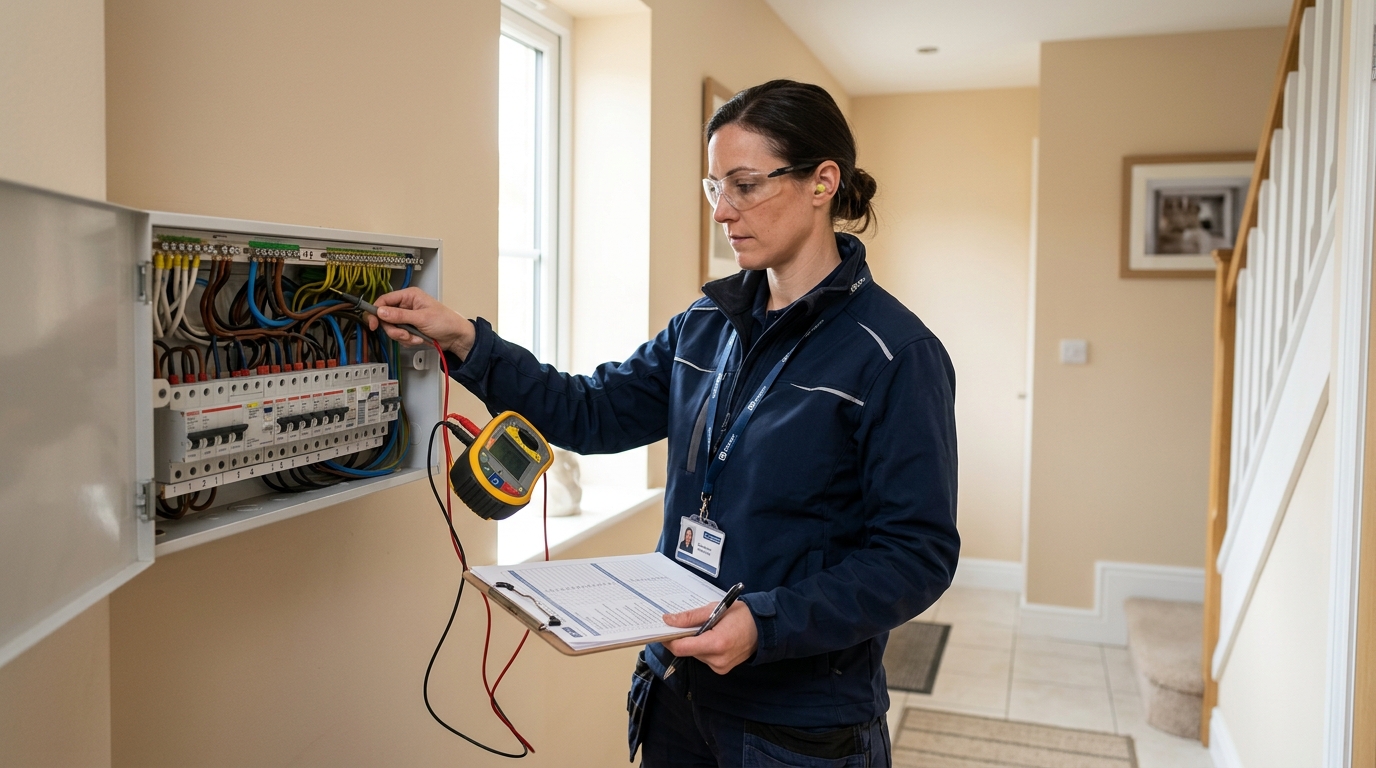
For Wiltshire period properties specifically, insurers of thatched and timber-framed homes routinely require an up-to-date EICR as a condition of cover. Without one, your policy may be invalid in the event of a fire or electrical incident.
As NICEIC-registered electricians, we carry out thorough EICR inspections across all of Wiltshire and provide clear, plain-English reports with prioritised recommendations. Where remedial work is needed, we can carry it out promptly and re-test to confirm compliance.
How We Conceal Modern Wiring in Wiltshire Character Properties
One of the biggest concerns we hear from owners of traditional Wiltshire homes is that rewiring will damage or visually compromise original features. It is a completely understandable concern, and it is one we take very seriously.
Our approach to concealing modern wiring in character properties is built around minimising intervention at every stage. Here are the primary methods we use.
- Chase and reinstate: Narrow channels are cut into plasterwork, cables are laid in, and the surface is made good to match the existing finish as closely as possible.
- Under-floor routing: Where suspended timber floors are accessible, cables are run beneath the boards without any surface disruption at all.
- Surface-mounted conduit: In rooms where chasing would compromise historic plasterwork, we install period-style trunking or conduit, painted to blend with the wall colour.
- Loft and void utilisation: Roof voids and ceiling cavities are used wherever the building’s construction allows, keeping cables completely out of sight.
- Careful socket and switch positioning: We discuss placement with you in advance so that the finished installation looks deliberate and considered rather than added as an afterthought.
Specialist Wiring Restoration for Thatched and Listed Buildings in Wiltshire
Wiltshire has a remarkable number of thatched properties, and for the owners of these homes, the electrical standards applied must go above and beyond what is required in a conventional dwelling. Thatch is an extremely combustible material, and even a minor electrical fault can escalate to a total loss within minutes.
Our specialist electrical work for thatched roof and heritage homes includes enhanced fire detection integration, smoke alarms wired into the mains circuit, and careful cable routing that keeps all wiring as far from the thatch as the building’s construction permits.
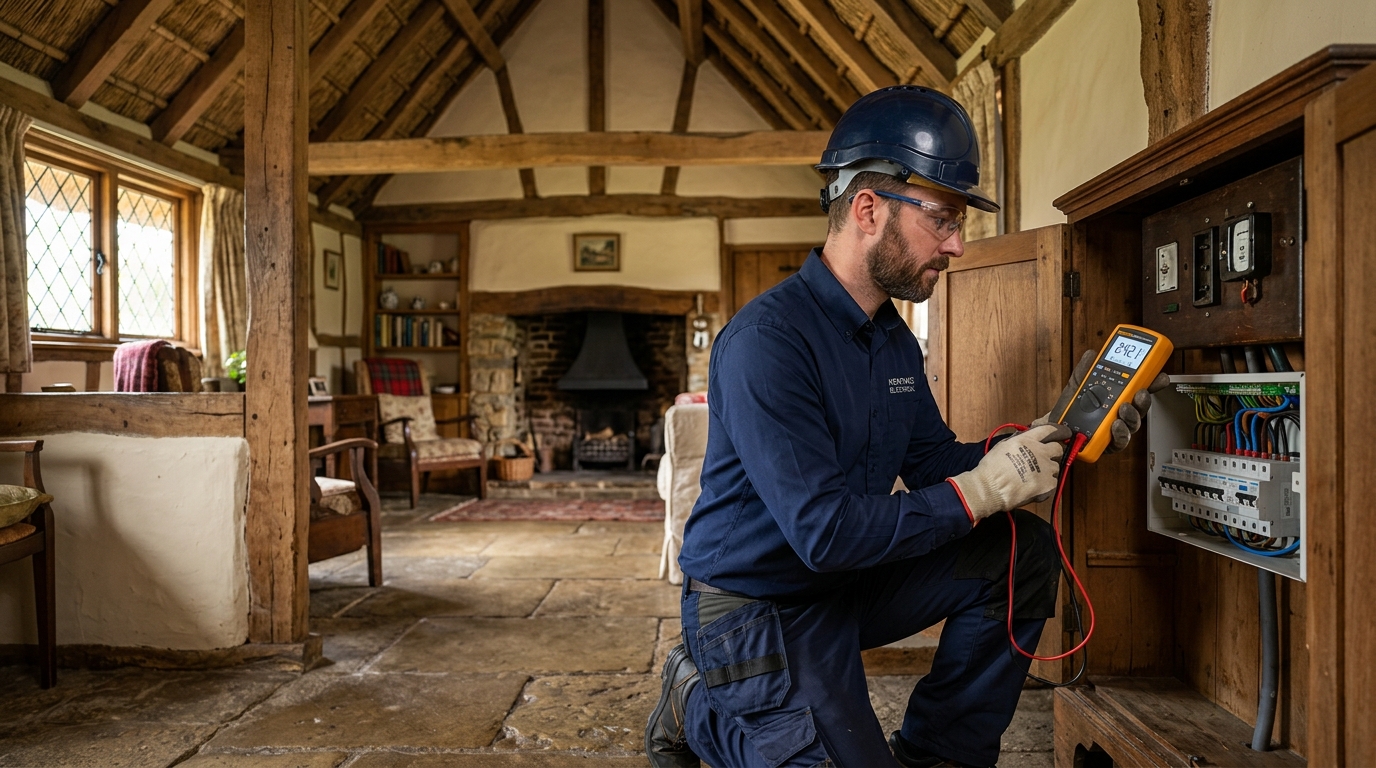
For Grade II listed properties, we work in close consultation with the homeowner to understand any consent conditions or planning restrictions that apply. In some cases, building regulations approval is required before electrical work can commence, and we can advise you on this process from the outset.
Professional Wiring Restoration Services Across Wiltshire: Areas We Cover
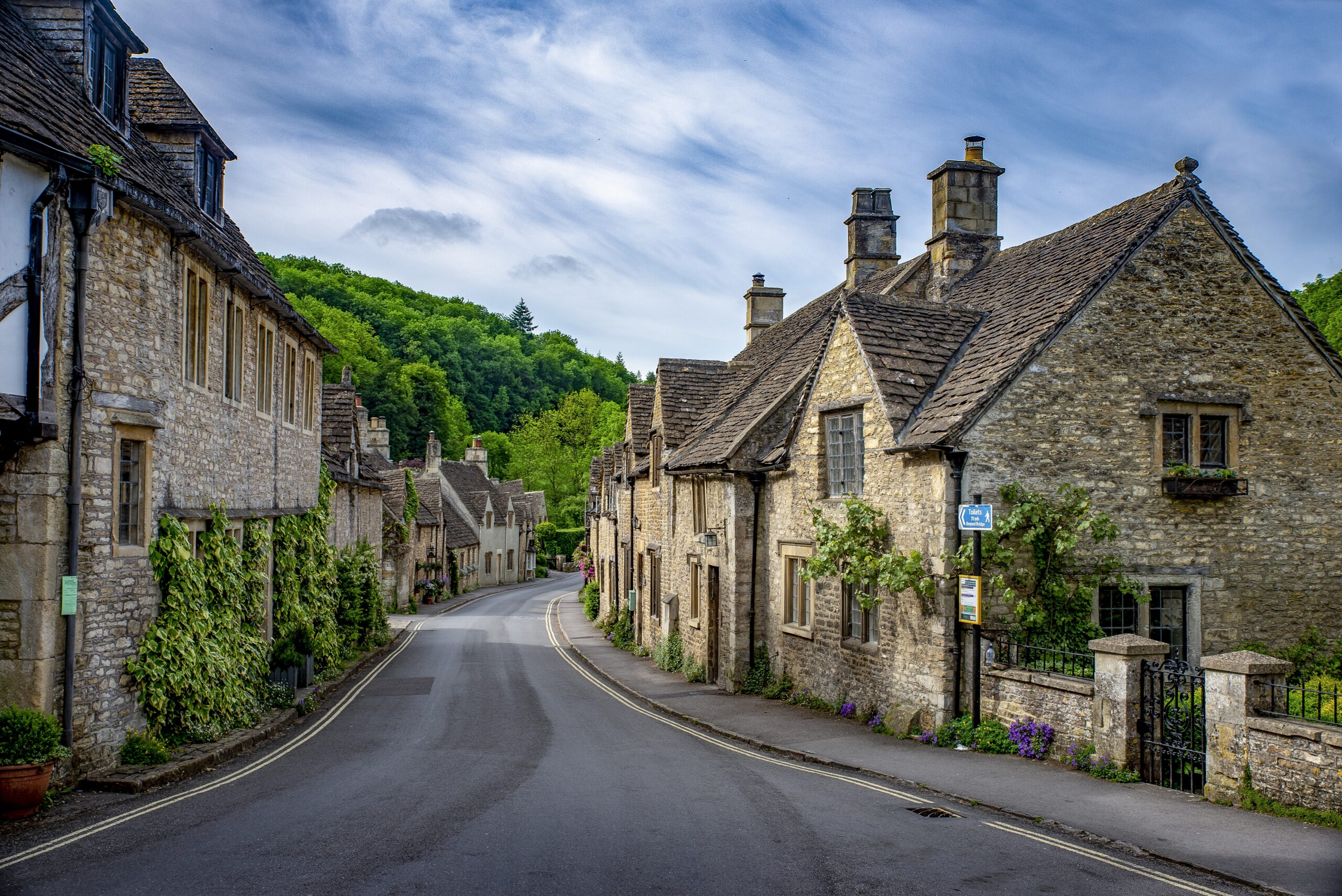
We cover the whole of Wiltshire, bringing the same standard of professional wiring restoration for traditional period properties to every corner of the county. Below is a summary of the areas where we regularly work.
| Town / Area | Notable Property Types | Service Link |
|---|---|---|
| Devizes | Georgian townhouses, Victorian terraces, rural farmhouses | Electrician in Devizes |
| Trowbridge | Historic mill buildings, Victorian residential | Electrician in Trowbridge |
| Chippenham | Stone cottages, pre-war semis, listed buildings | Electrician in Chippenham |
| Melksham | Mixed historic and inter-war residential | Electrician in Melksham |
| Marlborough | Thatched cottages, period high street properties, manor houses | Electrician in Marlborough |
If your property sits outside these towns but within Wiltshire, contact us directly. We work across the county and regularly travel to rural villages and hamlets.
Future-Proofing Your Period Property: Consumer Unit Upgrades and Smart Home Integration
A professional wiring restoration project is the ideal time to future-proof your Wiltshire period property for the demands of the next twenty to thirty years. By 2027, smart home adoption across the UK is projected to reach over 50%, with more than 15 million households expected to incorporate digital home technology.
Period properties do not have to lag behind modern new-builds in this regard. As part of our restoration work, we can incorporate the following alongside the core rewiring.
- Upgraded consumer unit with full RCD and RCBO protection, replacing outdated fuse boards
- Dedicated EV charging circuit run to the garage or driveway
- Smart lighting control wiring, compatible with systems like Lutron or KNX
- Wired smoke and heat detection to current standards, essential for thatched and timber properties
- Additional ring circuits to distribute load safely across larger homes
- Data cabling for wired internet connectivity, which period walls often block for Wi-Fi
All of these additions are planned and installed in a single programme of work, keeping disruption to a minimum and ensuring that your property’s character is preserved throughout.
Why Choose Greener Electrical for Professional Wiring Restoration in Wiltshire
Not every electrician has the knowledge, patience, or specialist experience to handle professional wiring restoration for traditional Wiltshire period properties. The combination of sensitive historic materials, complex consent requirements, and the need to future-proof for modern technology demands a very specific approach.
Here is why homeowners across Wiltshire consistently choose us for their period property wiring projects.
- NICEIC registered: All our work is certified and fully insured, with post-installation documentation provided as standard.
- BS 7671 compliance: Every installation meets the current UK wiring standard, keeping you covered for insurance and resale.
- Experience with heritage buildings: We have worked on thatched homes, listed buildings, and pre-war properties throughout Wiltshire and understand the specific challenges they present.
- Fixed-price quotes: No hidden costs, no surprises. You know what you are paying before work begins.
- Minimal disruption: We work room by room and clean up thoroughly each day. You do not need to vacate the property for the duration of the project.
- Local knowledge: We know Wiltshire’s housing stock, its local authority requirements, and the specific challenges of working in rural and listed properties across the county.
If you would like to know more about who we are and the principles behind how we work, visit our about us page for a full overview of our team and ethos.
Conclusion
Professional wiring restoration for traditional Wiltshire period properties is not simply a maintenance task. It is one of the most important investments you can make in the safety, compliance, and long-term value of your home.
Wiltshire’s rich stock of thatched cottages, stone farmhouses, Georgian townhouses, and listed rural dwellings deserves wiring that matches the quality of the buildings themselves. Ageing rubber cables, ceramic fuse boxes, and overloaded circuits have no place in a well-maintained period property in 2026, and the risks of leaving them in place are simply too significant to ignore.
Whether you need a full rewire, a targeted partial restoration, an EICR inspection before purchase, or expert advice on concealing new cabling within a sensitive historic structure, we are here to help. Our team of NICEIC-registered specialists has the experience, certification, and local knowledge to carry out professional wiring restoration for traditional Wiltshire period properties to the highest possible standard.
Contact us today for a no-obligation survey and fixed-price quote. You can also explore our full range of electrical services or browse our dedicated rewiring resources to learn more before getting in touch.
Frequently Asked Questions
Is professional wiring restoration worth it for a Wiltshire period property in 2026?
Yes, absolutely. Beyond the critical safety benefits, professional wiring restoration for traditional Wiltshire period properties significantly improves a property’s insurability and market value in 2026, particularly as buyers increasingly prioritise electrical compliance during surveys. The cost of restoration is far lower than the cost of a fire or a failed sale.
How long does a full rewire take for a period property in Wiltshire?
For a typical Wiltshire period property, a full rewire generally takes between five and ten working days, depending on the size of the property and the complexity of cable routing required. We work room by room to keep disruption to a minimum throughout the process.
Do I need listed building consent before rewiring a Wiltshire period property?
If your property is a listed building, some electrical works may require listed building consent, particularly if they involve any structural intervention or visible surface changes. We advise all our customers to confirm this with the local planning authority before work commences, and we can guide you through that process.
What is the difference between a full rewire and a partial rewire for a heritage property?
A full rewire replaces every cable, circuit, socket, switch, and the consumer unit throughout the entire property. A partial rewire targets specific circuits or areas identified as defective or high-risk, and is often appropriate when only one part of the installation has reached the end of its life. An EICR helps determine which approach is needed.
Can an old Wiltshire farmhouse be rewired without damaging original plasterwork?
In most cases, yes. We use a range of specialist techniques including under-floor routing, loft void utilisation, and careful surface-mounted conduit to route new cables with minimal impact on original plasterwork and historic finishes. We discuss the approach with you in detail before any work begins.
How do I know if my period property’s wiring is dangerous right now?
The clearest way to know is through an EICR carried out by a NICEIC-registered electrician. Common visible warning signs include fabric or rubber-covered cables, old ceramic fuse boxes, warm or discoloured sockets, and flickering lights, but many serious faults are hidden within walls and ceilings and only detectable through formal testing.
What does professional wiring restoration for a traditional Wiltshire period property include?
It includes a full survey of the existing installation, removal and replacement of all outdated cabling, installation of a new consumer unit with RCD or RCBO protection, upgrading of all sockets and switches, testing to BS 7671, and provision of an Electrical Installation Certificate. Additional elements such as EV charging circuits, smart home wiring, and enhanced fire detection can be incorporated into the same project.